
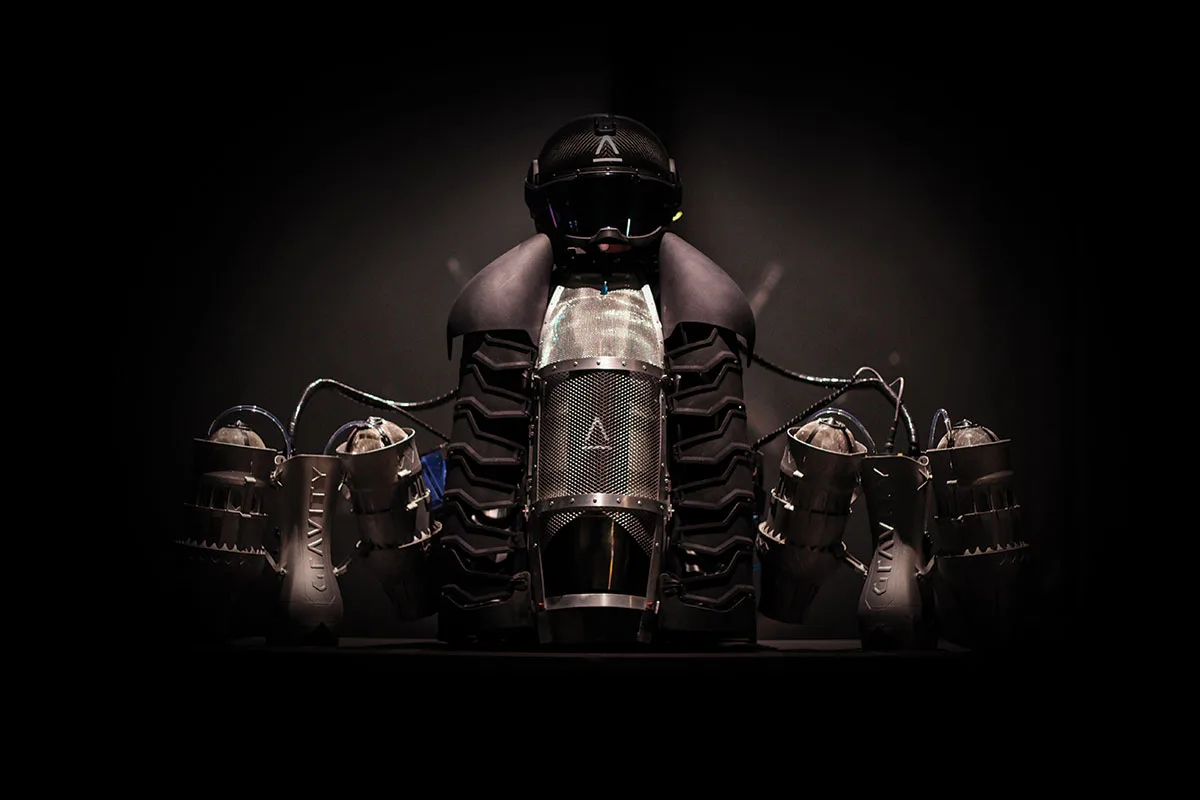
Richard Browning has been called a real-life Tony Stark, but his story begins with tragedy, not triumph. The founder and CEO of Gravity Industries grew up surrounded by aviation and invention. Yet also by the lessons of loss that shaped his mission to make human flight a reality.
A father’s dream
Browning’s father was an aeronautical engineer and inventor – he invented mountain bike suspension, taking the inspiration from the nose wheel of an aircraft. “My father was a maverick, a creator, a designer, an engineer,” Browning recalls. “So I’ve got aviation and building and engineering in my blood.”
But after being exploited by partners, Browning’s father took his own life when he was just 15. “I was an only child. That was a pretty big impact.” Looking back, Browning says, “I think I’m trying to make good on his audacious dream and desire to take a seemingly difficult, challenging, unlikely concept through to becoming a business success.”
Before Gravity Industries and building jet suits, Browning worked at BP as an oil trader and served six years with the Royal Marines. “I love the military, the discipline, focus and ambition. But I hate the command and control, just take orders part of military,” he says.
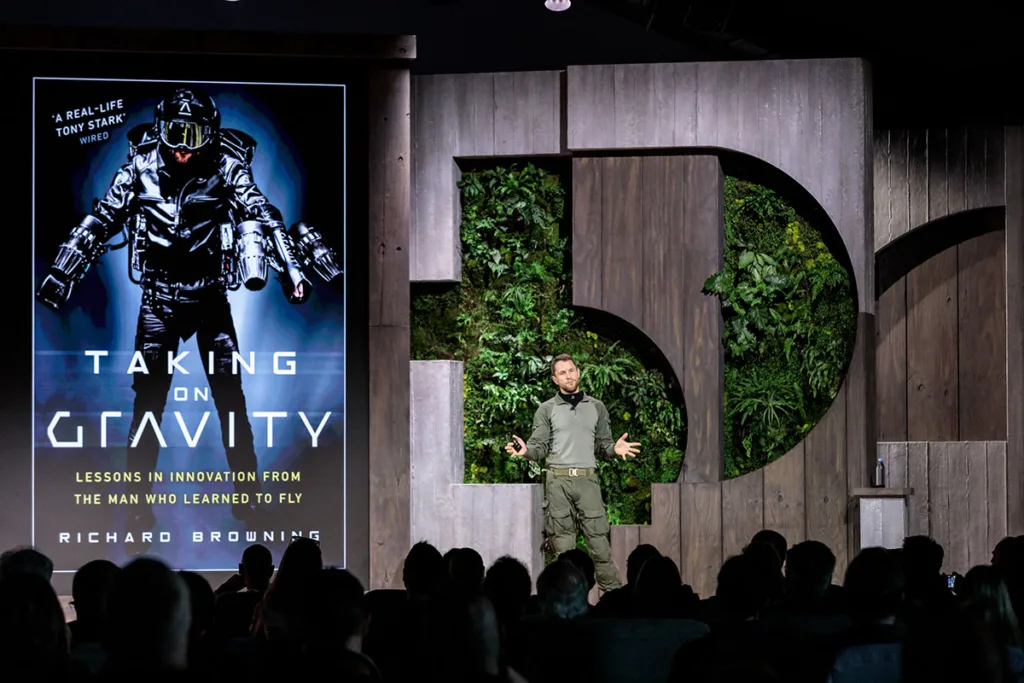
And with his experience trading oil, it set Browning up for the role of his life. “As a trader, you have to make rapid decisions off imperfect information, surviving lots of setbacks and failures. That sounds like entrepreneurship, right?”
Taking flight
In 2016, he began testing whether a human could truly fly using small jet engines. “Could you add a small amount of technology, and use your balance, your coordination and your physicality so that you could fly?” he asks, already knowing the answer.
Through “a very authentic series of recoverably failing experiments,” he managed to get off the ground with his first flight later that year. Gravity Industries was then created in 2017.
“We launched it on April Fool’s Day, sort of deliberately, and everybody shared it virally, thinking this is a crazy thing. About two days later, everybody shared it again, going, ‘I think it might be real’.” The clip went viral. “We did a billion impressions within a week.”
Venture capitalists quickly noticed, as Browning took his invention on the road, or the skies to be more accurate. After a TED Talk appearance, he dropped off in San Francisco to demonstrate his jet pack to Tim and Adam Draper, well-known venture capitalist, in their dusty parking lot.
“They rushed up to me afterwards and handed me a $100 bill,” Browning says. “That’s for cleaning up our parking lot,” they joked. The Drapers then negotiated with the jet pack founder for a 10 per cent share in his company for $650,000. That was Gravity’s first funding deal – sealed in a parking lot. Browning has the $100 bill framed on his office wall.
Getting down to business
Since then, Gravity Industries has turned a wild experiment into a serious business, with more than 400 events across 52 countries. “We’ve got a professional division that does defence and medic response and we’ve got the entertainment division, which does events, turns up, add some wowness.”
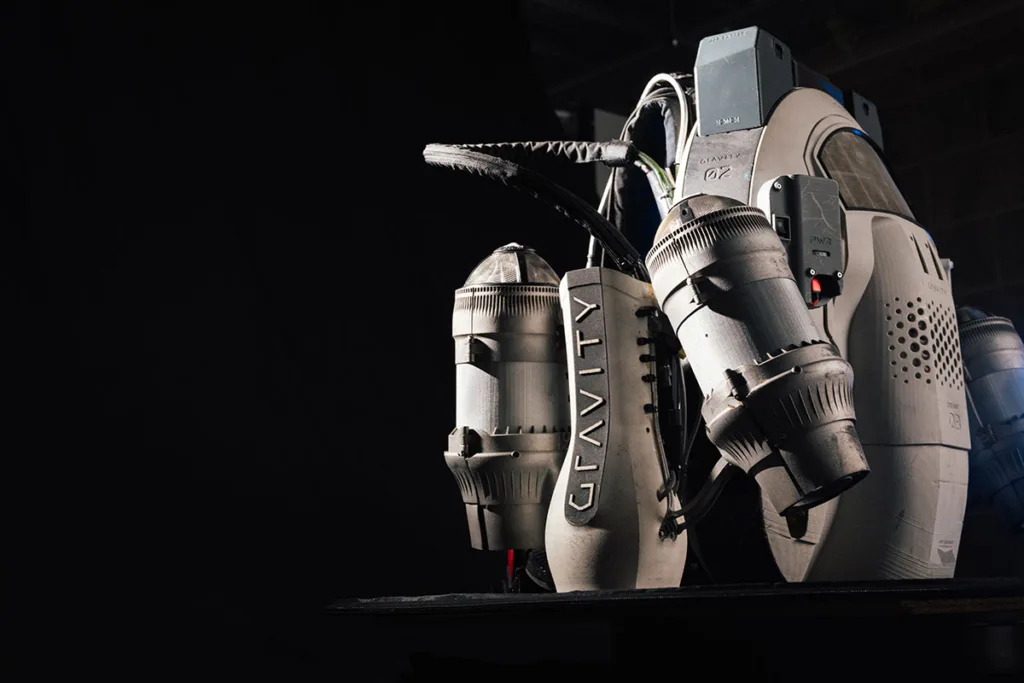
The suits have already been used in military and rescue environments. “We can move Special Forces and Special Forces medics in three dimensions over any terrain, night or day, over minefields, to do a job below radar and then self-extract,” he says. “We did that in Ukraine for a bit and it was just epic.”
While they are fun to fly, Browning insists his jet suits are not toys. “We did sell a couple to unnamed individuals for about half a million dollars. But even then, we insisted on training them. It’s like giving somebody a Formula 1 car, or in our case, it’s like having invented the helicopter and just going, ‘oh nice to meet you, I’ll just give you a helicopter. It’ll be fine. Just try not to hurt yourself’.”
Jetpack race
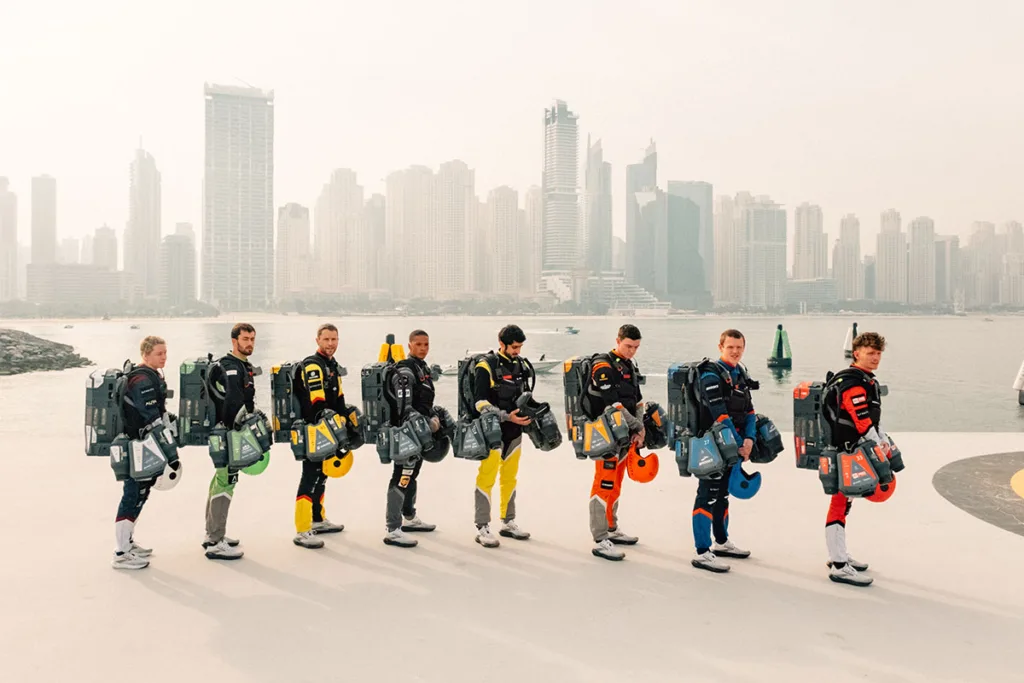
Dubai has become one of Gravity’s closest partners and the launchpad for its most ambitious public project – the world’s first jet suit race. “It was really successful in that with the backing of Dubai, we as a company actually broke even doing our very first race event, which is amazing.”
After the spectacle, Browning performed for Dubai Police and met the Crown Prince, Sheikh Hamdan bin Mohammed bin Rashid Al Maktoum, and even flew in his private gardens. “He loved it because obviously he’s a sporty kind of guy.”
The race captured Dubai’s futuristic spirit, Browning says. “Dubai’s journey from going from that classic photograph of one building and a road in the desert and then the leadership’s dream of ‘Let’s build something amazing, and the crowds will come’. They’ve delivered on that. That same spirit that believes in the impossible, that’s very aligned with our spirit.”
Browning’s team is now planning a full global race series. “It works really well. It’s really social media friendly and you’ve got guys and girls doing it. It sort of intersects with computer gaming, Esports, superhero Marvel stuff. Even the crashes are exciting but don’t hurt anybody.”
The business of innovation
Despite the showmanship, Browning is most passionate about what the jet suit represents. “I am super passionate about trying to bring to life the miserable little words of innovation and entrepreneurship,” he says. “They are long, fluffy words spouted by governments and corporate leaders without any real heart and soul half the time.”
For him, innovation means failing – and surviving. “Innovation is the failure-strewn process of starting with an often childlike, idiotic, probably impossible idea and survivably, recoverably failing your way to a point where you either get a breakthrough you never imagined, or it opens a door to something you didn’t even think of,” he explains.
“My father didn’t achieve it,” he adds. “That’s why I feel it really painfully from a safety, reputation and financial perspective. Can you keep failing your way to a breakthrough? Unfortunately, financially, he didn’t, and he ultimately didn’t survive the whole process. But it doesn’t need to be like that if you keep just assessing, just like any business leader does.”
A real-life Iron Man
Today, Browning, as CEO, founder and Chief Test Pilot, still flies at select events. “I am increasingly letting my 35-team member team fly rather than me,” he says. “There’s something more cool about me just pointing at the pilots rather than being a pilot.” Yet he still occasionally straps on the suit himself. “I was in an event in Bentonville only a couple of weeks ago, still flying. So I still keep my hand in.”

He has no plans to sell Gravity despite frequent offers. Based on its last fundraising round it was valued at $82 million. “I don’t think I would sell up and just sit on a bunch of cash, because I would then look at whoever was running it and think I just gave away probably the best job in the world.”
And for the world’s most recognisable jet suit pilot, that job is still about more than business. “The people in this company have given their absolute soul to what we do, and we all get on like a family. They’ll dig out at two in the morning in some crazy aircraft hangar in the Mojave Desert for five days straight in terrible weather, just to deliver.” And deliver they have.