
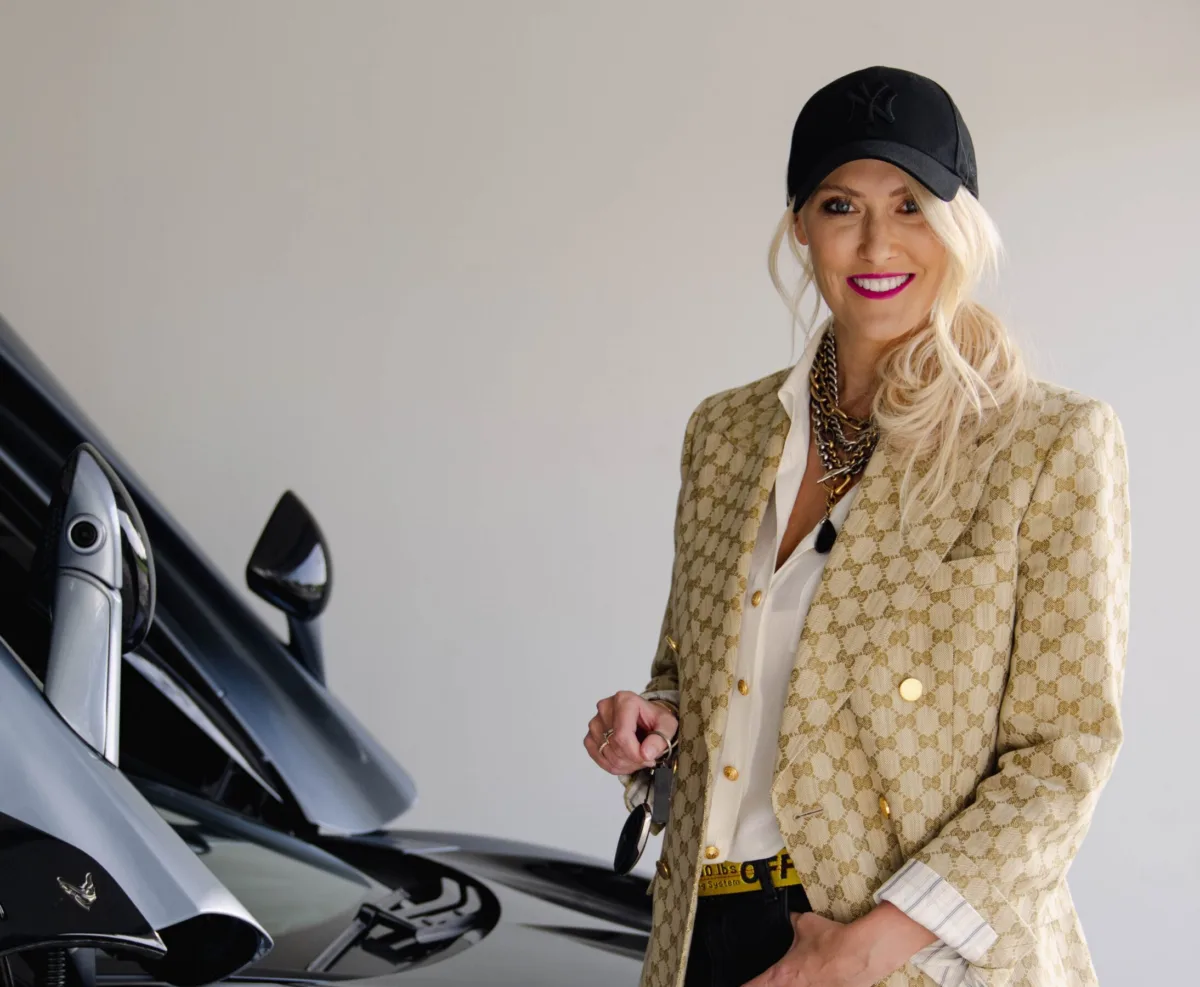
Founder Alex Hirschi has built a global platform that blends cool content, tech and commerce
Even when Supercar Blondie was clocking up viral numbers most media companies would sell their office furniture for, Alex Hirschi was already thinking several moves ahead. The audience was there. The credibility was there. The question was what to build on top of it.
“We have actually already expanded into luxury. In fact, we are a luxury car and tech brand,” says Hirschi. Today, Supercar Blondie is best understood as the front door rather than the whole house. Under SB Media Group, Hirschi has quietly assembled a global business that blends content, technology and commerce. Social platforms now generate around 1.5 billion views a month. The editorial site attracts roughly 10 million sessions. And the group’s luxury car auction platform has already sold more than 100 high-end vehicles worldwide.
What began with a phone camera and a curiosity about cars has matured into something far more deliberate – a luxury tech ecosystem built for how people actually discover, desire and buy at the top end of the market.
Dubai dream
Hirschi moved to Dubai in 2003, aged 22, fresh out of university and full of ambition she did not yet know how to monetise. “Coming to Dubai and seeing these incredible cars on a daily basis really piqued my interest even more so,” she says. “I’d always loved cars, but this gave me something to work towards.”
Dubai offered two things no other city could have at the time – density and access. Supercars were not hidden behind velvet ropes or private members’ clubs. They were parked outside hotels, idling at traffic lights, casually part of the urban furniture.
“When I started Supercar Blondie, the access to cars in Dubai was like none other,” she says. “No other city could have given me that kind of access to incredible cars.”
Early content was opportunistic. Weekends spent filming a friend of a friend’s car. Car events. Valet lines outside five-star hotels. But it worked. The city acted as an accelerator, not just for content, but for confidence.
Attention economy
For years, Supercar Blondie was dismissed by parts of the traditional car world as entertainment rather than enterprise. Hirschi never made that mistake.
“We have our own tech platform selling luxury cars around the world,” she says. “We have our website where our team of journalists around the world write about luxury goods – watches and jewellery and anything luxury that is coming out that is very cool and unique.”

The editorial platform launched two years ago. The luxury auction business followed roughly 18 months later. Both moves were about control – of narrative, of audience and ultimately of transaction.
Right now, that focus is squarely on SBX Cars. “The focus really is on building the luxury auction site,” Hirschi says. “It’s taking off. It’s on an upwards trajectory. That is very exciting.”
In the US, where online car auctions are already well established, uptake was swift. The UAE, by contrast, is still adjusting. “People are still getting used to buying cars over auction here,” she says. “There’s a little bit of education needed in the UAE market.”
That gap is precisely what attracted her. “There’s only been very, very limited auctionable cars in the luxury space in the UAE,” she says. “This is something that is going to get bigger and bigger.”
The appeal is straightforward – transparency, reach and fewer intermediaries. “It makes it so much better for people to get the price that they want, because you don’t really have to go through a middleman.”
EVs, AI and a resale headache
Hirschi is broadly optimistic about where technology is taking the car industry. “Technology is moving so quickly, especially with the capacity of batteries,” she says. “If you buy an electric car today, in two years’ time that technology will have moved on so much that it might be quite difficult to resell a car that you buy today.”
For mass-market buyers, that is inconvenient. For someone putting down $2–3 million on an electric hypercar, it is a serious question. “Will it still be relevant to a buyer? Will it be resellable?” she asks. “That’s something car companies need to think about.”
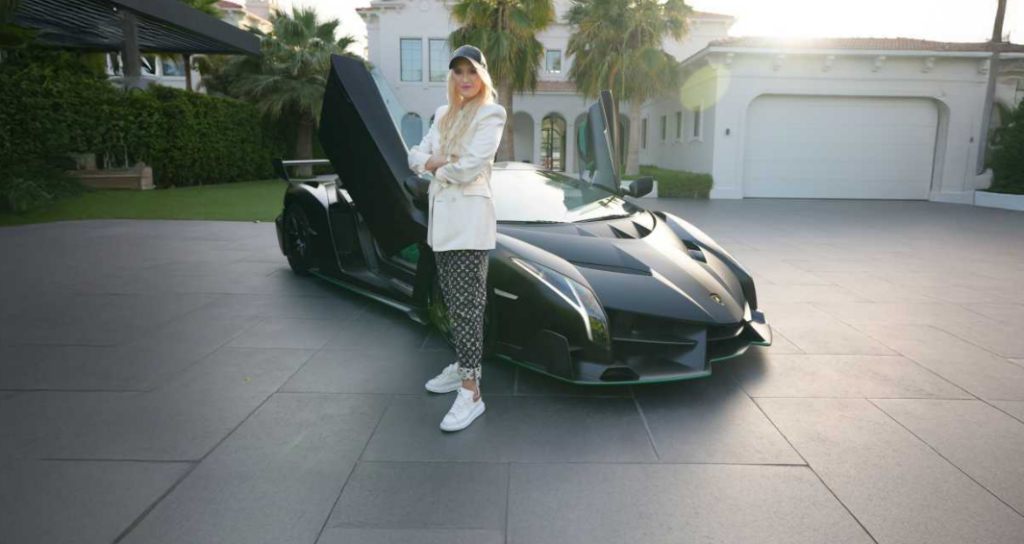
Her proposed solution is pragmatic rather than ideological. “If technology changes so rapidly, can we make sure we’re making cars today where the technology can be swapped out for the new tech, so they don’t just become dead weight?”
Add to that the speed of innovation coming out of China and the pressure on legacy manufacturers intensifies. “China is launching new cars into the market with the latest technology faster and quicker than traditional car manufacturers,” she says. “Legacy auto makers will continue to have a tough time competing with that pace of innovation at competitive prices.”
AI, by contrast, excites her. “Cars are no longer just for transportation,” Hirschi says. “They’re now really an extension of our lives.”
Manufacturers are already talking about vehicles as living spaces rather than machines. “I’m looking forward to seeing how our cars can be even more integrated into our lives and what other functions they can provide.”
When your name is the brand
For all the scale, Hirschi remains acutely aware that Supercar Blondie still carries her face and name. That brings advantages – and pressure. “Every single interaction from my team to the car world is a reflection of me,” she says. “If someone is upset, they’re going to come to me.”
That responsibility shaped some punishing early years. “I didn’t have a day off in four years,” she says. “Not one day off. I felt like I could never be offline – and I really couldn’t be.”
This year, she took a rare break to deal with personal matters and discovered something that most creator-led businesses never test. “Everything can run without me,” she says. “And it can run very well.”
The pressure, she admits, has eased. “The pressure was enormous when building the business,” she says. “But now I’m so grateful I’ve been able to build a team that represents me and the brand so well.”
Emotion without engines
As cars become more digital, some argue they are losing their soul. Hirschi is unconvinced. “I agree in one sense, but I disagree in another,” she says. “A car doesn’t need to have a loud engine note to be appreciated.”
Removing the engine, she argues, frees designers rather than limits them. “Designers don’t have to design the entire car around an engine anymore,” she says. “They have so much more freedom in design language now.”
Sound, sensation and experience can evolve too. “Cars don’t need to sound like what they’ve sounded like for the last 100 years,” she says. “We basically have a blank slate.”
One of the quiet reasons Supercar Blondie scaled so quickly is that it never tried to impress traditionalists. “My audience never really started with petrol heads,” Hirschi says. “The car world has been quite insular and intimidating for many years.”
Her approach stripped away the gatekeeping. “I’m not a car expert. You’re not a car expert. Ninety-nine per cent of the world aren’t car experts,” she says. “But a lot of us still love and enjoy cars.”
By focusing on design, technology and experience rather than engine specs, she made cars accessible – and future-proofed the brand as the industry itself evolved.