
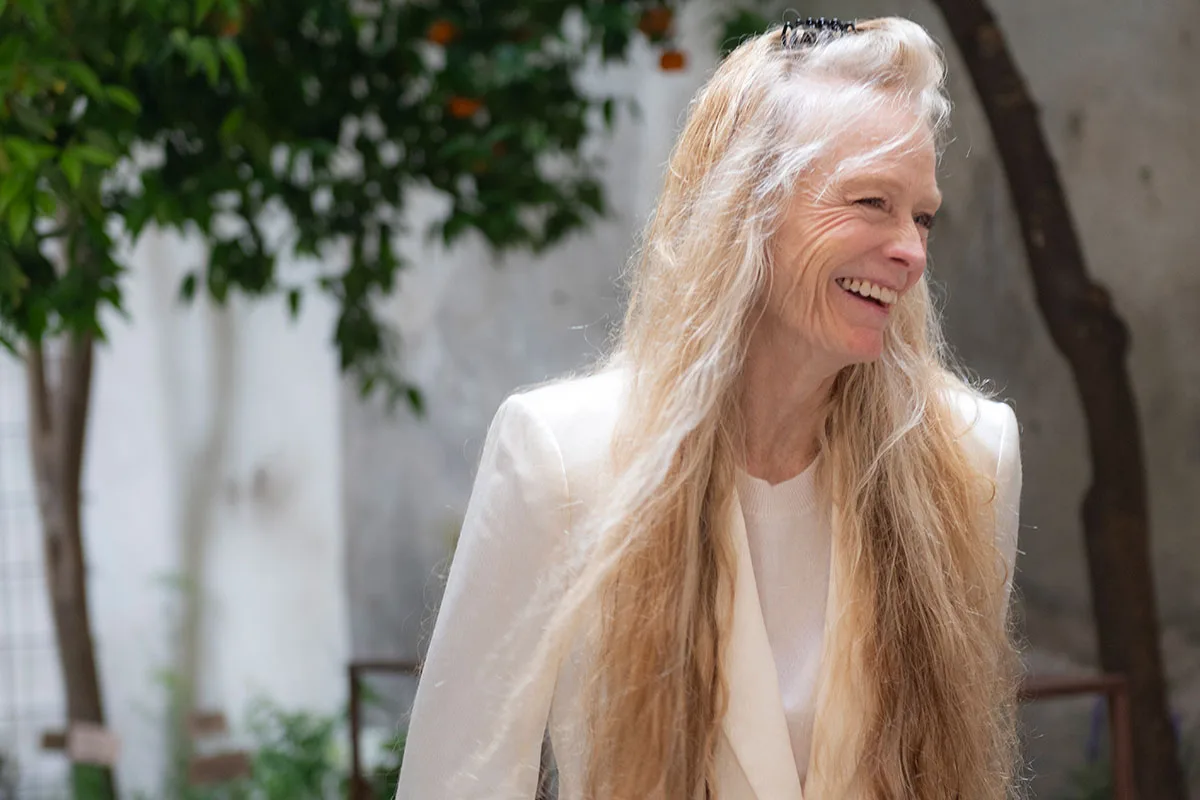
There are few figures in global fashion as quietly influential – or as purpose-driven – as Suzy Amis Cameron, CEO and Founder of Inside Out. A lifelong social entrepreneur who works across continents to tackle some of the world’s most urgent sustainability challenges, she has spent years championing a radical but deceptively simple idea: what we wear should support our bodies, protect the planet and create long-term value for future generations.
Now, with Inside Out’s acquisition of The Simple Folk – the child-health-first luxury brand she co-founded – Amis Cameron is doubling down on the Middle East. Not as a satellite market, but as a region she believes can redefine how the industry thinks about purity, wellbeing and regeneration. Her message is clear: fashion is overdue for its transformation, and the Middle East is uniquely positioned to lead it.
Responsible fashion
Ask Amis Cameron why the Middle East has become such a strategic centre of gravity for her work, and she doesn’t hesitate. “My commitment to the region grew from seeing how closely its values align with the missions of Inside Out and The Simple Folk,” she says. “There is remarkable energy here around building systems that are healthy for people and the planet, not just profitable in the short term.”
It’s a sentiment increasingly echoed by global brands testing the Gulf as a proving ground for sustainability-led expansions. But for Amis Cameron, the attraction runs deeper. She points to the region’s cultural heritage, respect for craftsmanship and the bold vision of its leaders – all converging with a young, environmentally aware population.
The combination, she says, creates a rare opportunity: a place where fashion can evolve without the legacy constraints that slow progress elsewhere. “Innovation and tradition coexist here,” she notes. “The region can become a global standard for fashion that supports human health and the environment, blending tradition, science and innovation in ways others can learn from.”
Fashion becomes infrastructure
The Simple Folk has long been admired for its purity-first philosophy — organic materials, low-impact production, and a fierce commitment to children’s wellbeing. Inside Out’s acquisition marks a turning point, expanding those principles into a broader global platform.“Inside Out shares our belief that fashion can be more than clothing. It can support health, nurture the planet and create lasting value for future generations.”

This is where her concept of “fashion as infrastructure” takes shape. Her argument is that garments should behave like a support system for life: safe, restorative and built to last. Inside Out aims to systematise this, integrating scientific intelligence into every stage of a garment’s journey – from fibre selection and dye chemistry to manufacturing, distribution and final use. “Fashion should contribute to the health of future generations rather than burdening them.”
A new era of wellbeing
Where the broader industry has often relied on marketing to signal sustainability, Amis Cameron insists on scientific evidence. For her, the future of fashion lies in material innovation, chemical safety, supply-chain verification and transparent data.
“Science allows us to understand the true impact of materials, dyes and manufacturing processes on both human and environmental health,” she says. “Technology enables us to scale these insights, creating systems that can reliably produce clothing that maintains transparency and accountability.”
It’s why Inside Out invests heavily in R&D. Advances in safer dye processes, non-toxic finishes, and regenerative fibres are already reshaping the architecture of modern fashion. Supply chain technology ensures traceability: no greenwashing, no opacity, no hidden chemicals.
It is also why she sees such strong alignment between The Simple Folk’s origins and the future of Inside Out. What began as a mission to eliminate harmful chemicals in children’s clothing now expands to a global philosophy – design garments that are safe, restorative and regenerative for everyone.
“We wanted to make the choice simple for families,” she says. “Remove the trend cycles, remove the noise, and create clothing measured by its positive impact on people and the planet.”
Child-health-first luxury
One of the most defining ideas Amis Cameron brings to the industry is “child-health-first luxury.” It is, she insists, the most important shift happening in family-focused fashion today.
“Children’s bodies are uniquely sensitive to the chemicals and microplastics common in the industry,” she explains. “Their skin, their nervous systems, their development – they all require the purest and safest possible materials.”
The concept has resonated globally, driven by a new generation of conscious parents demanding more transparency and integrity. “Parents want honesty, safety and seriousness,” she says. “The industry has a responsibility to meet those expectations.”

Profit with purpose
One of the enduring questions for brands entering the Gulf is how to balance purpose with profitability. For Amis Cameron, the two are not in tension, at least not in this region.
“The Gulf is home to highly knowledgeable consumers who value quality, purpose and longevity,” she says. “This creates a strong environment for brands that prioritise meaningful products rather than high-volume production.”
Her advice to brands is straightforward: communicate openly, build long-term local relationships and embrace circular, regenerative materials. Waste reduction and supply-chain transparency are not optional add-ons; they are strategic advantages.
“In such a dynamic and future-focused region, doing the right thing is a competitive advantage,” she says. “Consumers reward brands that align with their values and with the region’s long-term vision for sustainable progress.”
The phrase “regenerative innovation” appears often in Amis Cameron’s work. For her, it represents fashion’s next frontier. Practically, this means fibres that rebuild soil, garments that last longer and can return safely to nature, and supply chains that uplift rather than exploit communities. Her vision is both ambitious and optimistic. Fashion, she believes, can heal more than it harms. And the future we wear can – and should – be better than the past.