
Most universities sell the promise of preparing students for the real world. Tetr College of Business has taken a far more literal approach: it sends them into the real world every single semester. Across seven countries, eight terms, and multiple hands-on ventures, students are pushed to build businesses, fail, recover, collaborate across cultures and develop the sort of resilience that no traditional classroom can teach.
Founded by Wharton-educated entrepreneur Pratham Mittal, Tetr is positioning itself as a modern reimagining of higher education. It blends elements of a university, a startup incubator and a round-the-world trip.
Learning by leaving
The concept came out of Mittal’s own frustration with how little he learned inside a conventional classroom. “When I was at Wharton, most of my real learning happened through travel,” he says. “Every semester I studied abroad – China, Ghana, London, India. That’s when my mind expanded. Inside the classroom, I would cram the night before an exam and forget it the next day.”
His real education happened while running his first startup. “My marketing lessons came from missing my targets, not from a lecture by a professor,” he adds.
That lived contrast – between theory and experience – shaped Tetr’s model. Students touch down in seven countries over four years, building a different venture in each. They learn distribution in Dubai. They build a direct-to-consumer brand in India. In Singapore, they design hardware and launch Kickstarter campaigns. In Ghana, they form NGOs and raise funds for local impact projects. In Argentina, they develop sustainability-focused ventures. A final internship and a semester in the US, anchored in New York with a Silicon Valley immersion week, rounds off the journey.
“It’s the best of a top university and an incubator rolled into one,” Mittal says.
Small but global
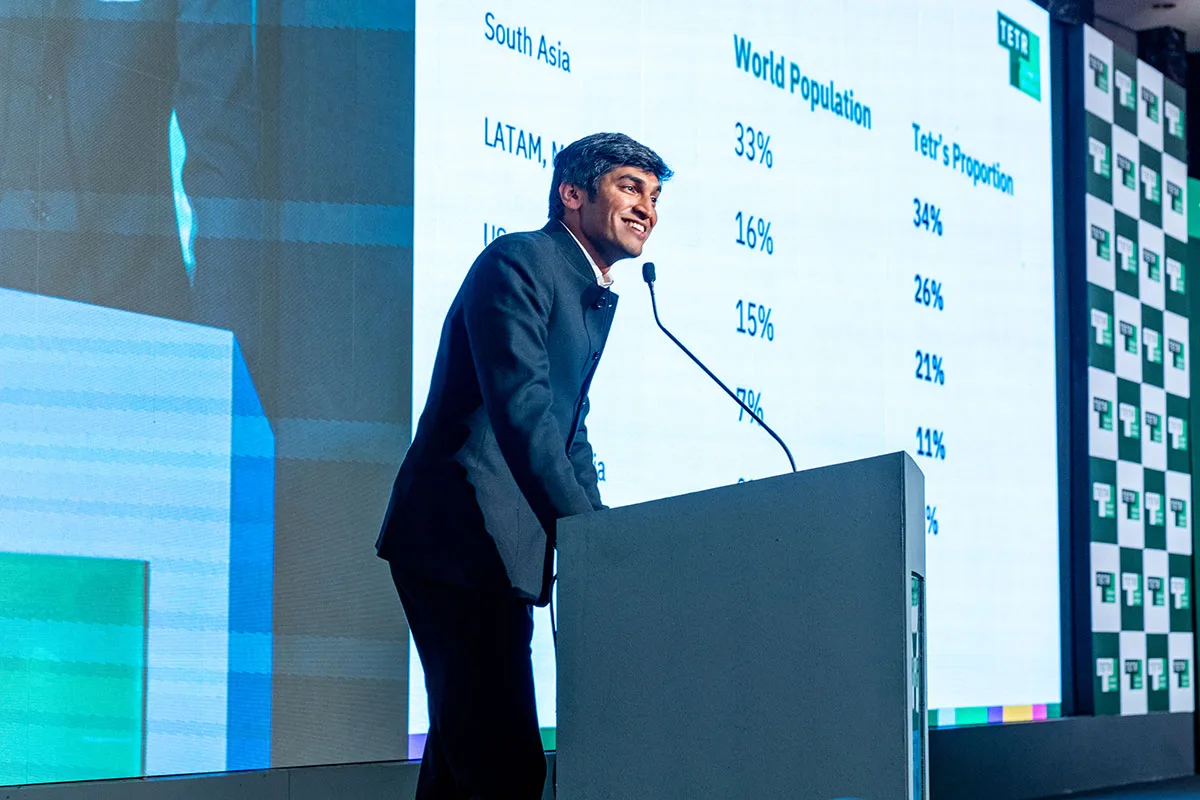
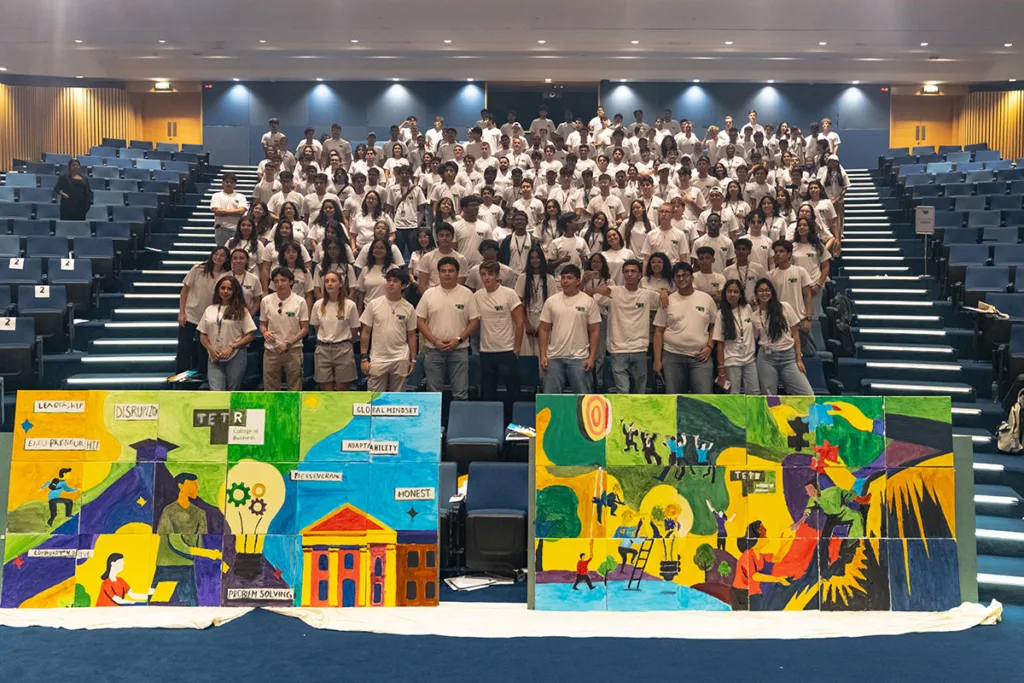
Tetr is intentionally niche. Mittal stresses it will never become a mass institution. “We’ll stay small – maybe 1,000 to 1,500 students,” he says. Demand, though, is strikingly global: 300 students from 60 countries, with an almost perfect distribution matching global population proportions. “India is about 20 per cent of the world, and 20 per cent of our cohort. The US is 7–8 per cent, same here. The only exception is China due to visa issues, but Chinese students join next year.”
Despite its unconventional structure, Tetr delivers accredited qualifications. Students graduate with UK or US-awarded bachelor’s or master’s degrees, thanks to articulated partnerships.
The surprise for many is the pricing. “We are half the cost of a US education,” Mittal says. The full four-year programme, including travel and accommodation, is around $250,000 – and heavily subsidised. “Average scholarships were 70 per cent in year one and 50 per cent in year two. Most students end up paying very little.”
The startup sprint
Tetr’s incubator-style design forces students into real-world decision making. Every term, they build something new – and most fail at least once. But Mittal is clear: failure is not a flaw. “The goal is learning. A student could get an A with zero revenue if they tried, experimented and pushed themselves. They could get a C even with high revenue. The business outcome is a bonus.”
Twenty to thirty per cent of ventures succeed and continue into later semesters. Others are reset. The emphasis is on grit, iteration and cultural competence.
That cultural dimension is not a side benefit — it’s central. “Put an Indian, a Mexican, an American, a Pakistani and an Emirati together and tell them to collaborate on day one – it doesn’t work,” Mittal says. Tetr now begins each country with a week-long orientation on cultural nuances and practical life skills: how to get things done in Dubai, how to navigate Singapore, how to work in India, how to avoid missteps in Ghana.
These early social bonds are crucial. “Students must know how to work with different nationalities. After travelling so much, they can speak to anyone like a native.”
AI tutors, EQ and the human advantage
One of Mittal’s biggest internal learnings has been the role of AI. Tetr is now doubling down on personalised AI tutors to help teach fundamentals. AI isn’t the threat the education sector fears, he argues.
“No AI can teach you how to cope with a breakup, failing a course, or receiving a tax notice for your first business.
Those experiences built my character. We’re not about exams, grades or slides. Those can be gamed by AI. We’re about everything that happens outside.”
Tetr’s ambitions are unapologetically lofty. Mittal wants Tetr to become a globally ranked top-10 university alongside Wharton, Stanford and Harvard. Yet he insists the institution will not expand aggressively. “We’re already in seven countries. That’s a lot to manage. We’ll take five-year increments, stay small, stay focused on business and engineering.”
Shorter tracks, two-month global programmes and more executive education modules are coming, but slowly. For now, the flagship four-year world tour remains the core.
The trust factor
The biggest challenge? Trust. “We’re new. I’m 34. Parents must trust us with something bold and unconventional. That takes time.” But momentum is building. Year one saw 100 students. Year two has doubled that. Word of mouth and social media drive most applications – advertising is minimal. If the early cohorts are any indication, Tetr might just become the model for a fully global business education — one where learning isn’t confined to a classroom, but discovered across continents.