
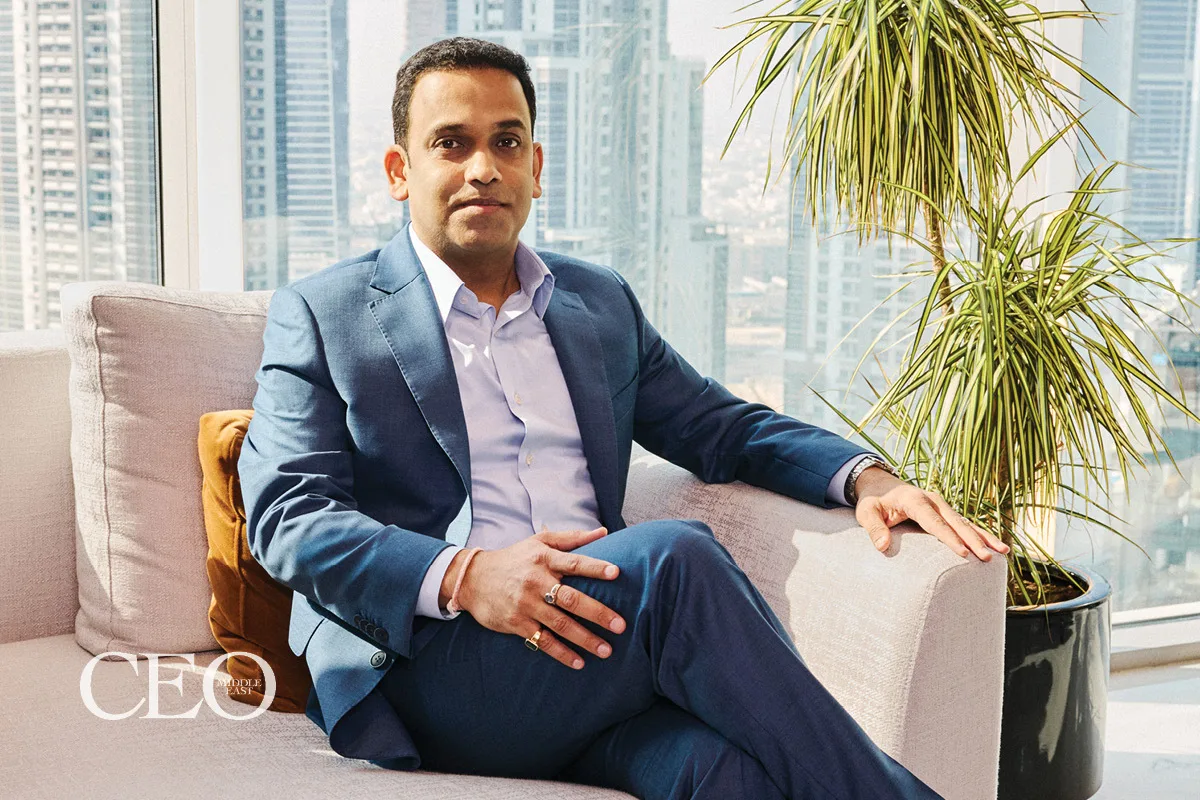
In a city defined by ambition, few developers embody Dubai’s fearless spirit quite like Navneet Mandhani, Founder and CEO of Karma Developers. Sitting in his Dubai office, Mandhani speaks with the composure of someone who’s seen markets rise, fall and rise again. His tone is measured, his ideas clear. “We’re not building structures and trying to hard-sell them,” he begins. “We’re building communities – and that means understanding where people want to live, not just where investors want to buy.”
For Mandhani, his entrepreneurial legacy was written long before Karma Developers took shape. “Enterprise is in my DNA,” he says. “I come from a family of entrepreneurs, and after studying in the US and working for Fortune 500 firms, I knew I wanted to build something of my own.” That drive first took him into technology and trading, and eventually into real estate – a sector he has reshaped with both pragmatism and purpose.
The early years
Mandhani’s career began in technology when he founded Voyzze Communications, a North American VoIP company that helped strengthen digital infrastructure across the region. Later, he backed Yourkeys.com, a UK proptech startup digitising the home-buying journey, years before “proptech” became a buzzword. “It was a calculated risk,” he recalls. “I’d seen how inefficient the process of buying property was in London. Yourkeys solved a real problem.”
The platform’s later acquisition by Zoopla validated that vision. “It proved that entrepreneurial risk only makes sense when it’s tied to purpose,” he says. That belief – solving problems that matter – became the foundation of everything he built afterwards.
Before turning to property full-time, Mandhani immersed himself in the global commodities sector. “You learn to manage risk, understand cycles, and act when others hesitate,” he explains.
Doing what others avoided
That contrarian instinct later defined Karma Developers. “We founded Karma in 2013, right after a slowdown. Most people saw risk; we saw opportunity,” he recalls. Alongside co-founder Capt. Pradeep Singh and veteran architect Shahzad Saxena, Mandhani set out to create a company that would thrive by doing what others avoided.
“We’ve always taken the road less travelled,” he says. “While major developers concentrated on Downtown and Palm Jumeirah, we ventured into emerging corridors like Dubai Investment Park (DIP), Falcon City, and Dubai Silicon Oasis-locations that were largely overlooked at the time, but where we recognised immense potential.”

That bet paid off. Karma’s first project in DIP, called Olivia, sold out quickly and set the tone for a decade of steady growth. “When the market looked bearish, we doubled down,” Mandhani says. “After Olivia’s success, we increased our bet five-fold and began planning a gated community of over 1,200 apartments – 70 per cent dedicated to green spaces and water features.”
Affordable luxury
For Mandhani, real estate is not just about location and returns – it’s about purpose. “Back in 2013, I asked myself, ‘Why should quality living be a privilege for a few?’” he says. “Dubai had super luxury towers for the elite and uninspired mid-market blocks for everyone else. The professionals driving the city’s growth were underserved.”
That question shaped Karma’s mission: affordable luxury. “It doesn’t take much to elevate design and quality,” he explains. “Our goal was to convert tenants into owners – to give people a home they’re proud of without pricing them out.”
He gestures to renderings of Karma’s projects in Arjan, Falcon City and Dubai Silicon Oasis. “Look at Trinity in Arjan. You won’t find another building like it there. We wanted to prove that good architecture and affordability can coexist.”
Today, other developers are following suit. “When we started, no one wanted to touch these areas,” he says. “Now we see others coming in. That’s fine as it validates our strategy. But affordable luxury will always sell. People want value.”
Mandhani has watched Dubai’s property cycle evolve over a decade. The most striking change, he says, is in the buyer base. “Before Covid-19, most buyers were from India and Pakistan. Today, money is coming from Germany, Poland, the US, France, Turkey and China. These aren’t flippers. They’re young professionals and entrepreneurs who want to live here.”
That shift influences Karma’s design philosophy. “Not everyone walks in with 20 or 50 million dirhams,” he says. “Our buyers are putting down their life savings – one and a half to three million dirhams – to stop renting and own something. They want homes that feel aspirational but remain attainable.”
Leadership and legacy
When asked about his leadership style, Mandhani laughs. “We’re control freaks,” he admits. “We delegate, but we like to stay on top of everything – design, finance, sales. It’s how we’ve built trust and consistency.”
That approach is sustained by a loyal core team. “We’ve been working together for over 15 years. Everyone knows what needs to be done,” he says. “You don’t need long explanations when you’ve built that kind of chemistry.”
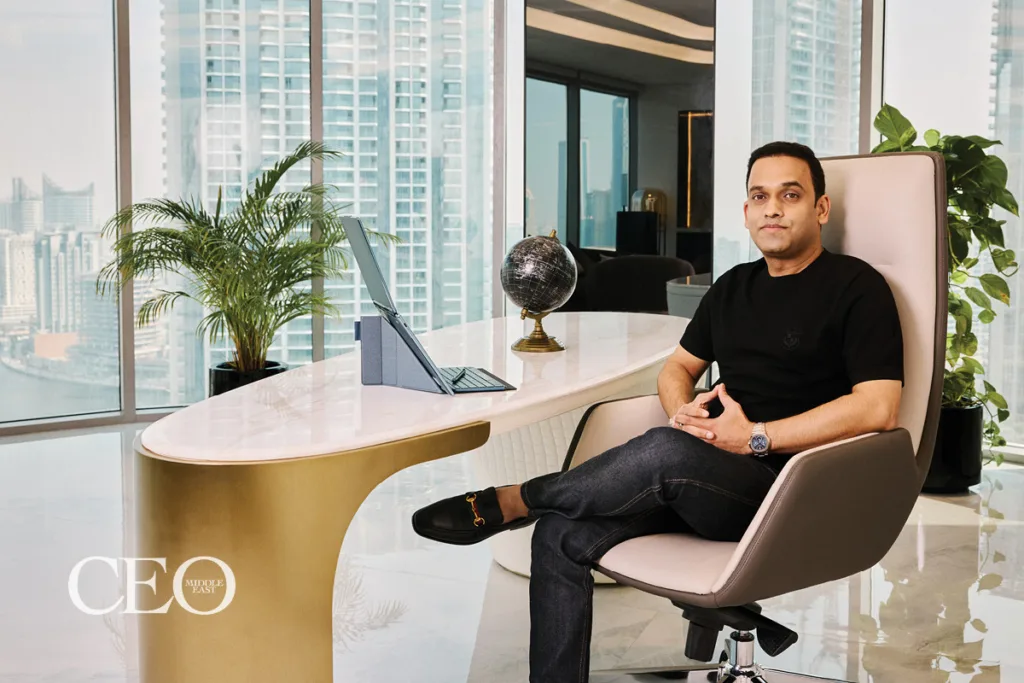
A typical day starts early. “I’m up by seven. Training from 7:30 to 8:30 with my trainer, then I’m on the phone, checking finance, sales, procurement reports. By the time I reach the office, the emergencies are already handled.”
He spends most of the day meeting landowners, architects and project heads. “The land market in Dubai is tight,” he says. “If you’re not aware of who’s buying what, you’re left behind.”
Despite his intensity at work, Mandhani keeps boundaries at home. “My wife and I both worked in tech in the US. Early on, we decided to keep business and home separate – it keeps our balance clear and our respect strong.”
Building communities
The next chapter for Karma Developers is its most ambitious yet: building a full-scale gated community in Dubai Investment Park. “It’s a dream for any developer,” he says. “We’ve done standalone buildings and boutique collaborations. But this is the first time we’re building a complete community.”
The project will roll out in phases. “It’s a long-term commitment,” he explains. “But that’s what makes it exciting. It’s about more than smart homes now – it’s about catering to human psychology, to wellness, to a sense of belonging.”
By 2013, when Navneet moved to the UAE, he had already built a broad global footprint through ventures across multiple sectors and geographies including Singapore, Hong Kong, London and beyond. With that experience and network, he recognised Dubai as the ideal hub to translate his international business acumen into building enduring real estate value.
Cyclical thinking has helped him balance global volatility. “Markets rise and fall. In 2014, when Dubai slowed, Cyprus and London were strong. In 2020, the world shut down, but Dubai bounced back fastest. Diversification gives you resilience.”
Alongside that global perspective, he insists Dubai remains unmatched. “I haven’t found a better market,” he says. “We’ve explored Saudi, Egypt, even Ras Al Khaimah, but our conviction stays here. Dubai can absorb corrections. It’s where momentum lives.”
For Mandhani, real estate success is built on fundamentals, not speculation. “We’ve always followed a minimal-debt philosophy,” he says. “Growth has to come from strength, not leverage. That’s why we’ve remained stable through cycles.”

Value creation
Karma’s focus on sustainability reinforces that philosophy. “We integrate LEED Gold standards wherever possible,” he explains. “Sustainability isn’t marketing – it’s value creation. If you build responsibly, your project holds value longer.”
His timing, he admits, has been fortuitous but not accidental. “I don’t want to sound pompous, but our timing with land acquisitions has always been right,” he says. “You stay patient, analyse the data and trust your instincts.”
Value creation is not always about personal profit, and philanthropy remains central to his worldview. “Business must serve society, not just shareholders,” he says. Through Karma Cares, he supports causes like the Dubai Autism Centre and children’s shelters in India. During the pandemic, he personally funded flights for stranded workers. “We didn’t talk about it publicly,” he notes quietly. “It just felt like the right thing to do.”
As Dubai marches toward its 2040 Master Plan, Mandhani sees alignment between the city’s vision and his own. “We’re focused on sustainable, wellness-centric, design-led communities,” he says. “Disruption isn’t a spark of brilliance; it’s a commitment. Stay rooted in purpose, obsess over the end-user, build resilience and innovate responsibly.”
The global entrepreneur leans back, clearly deep in thought. “We’ve built villas, towers, partnerships,” he says. “Now we want to build legacies. Not just buildings, but communities where people thrive.”