
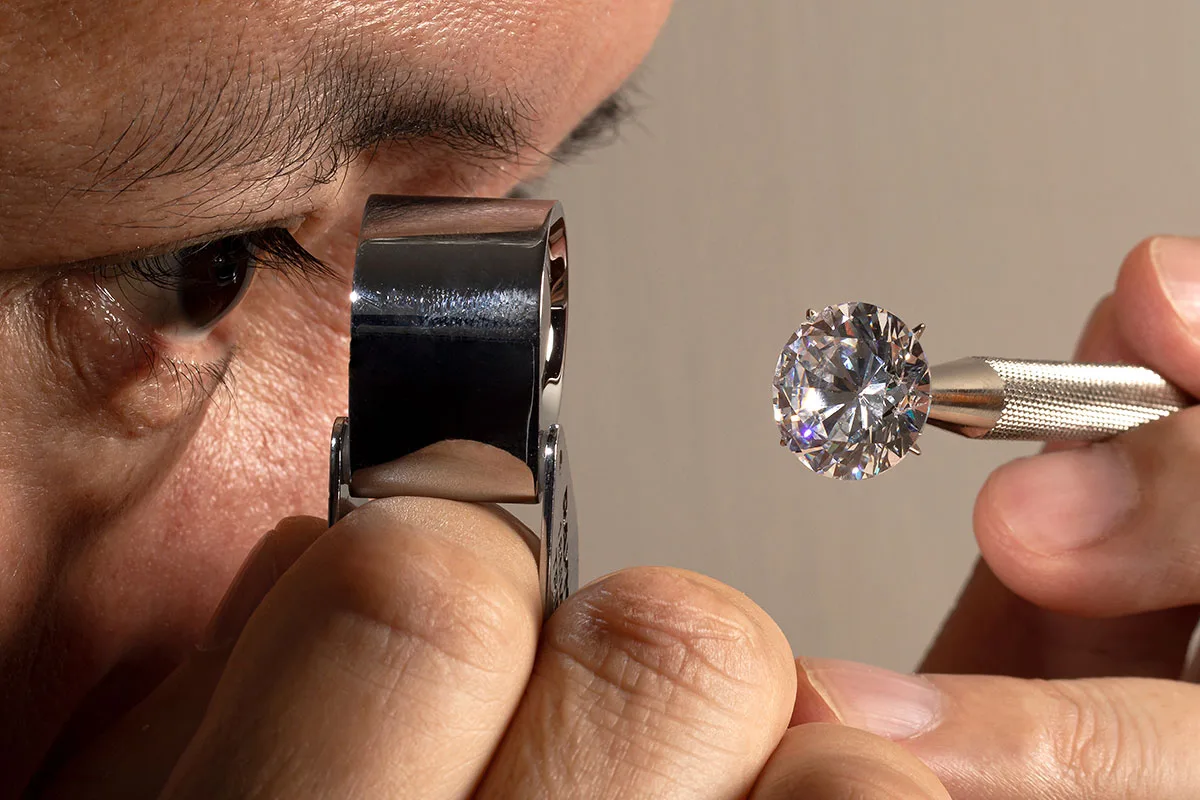
When NatHalie Morrison says “we have been lied to,” she isn’t raising her voice or banging the table. She says it the way a jeweller examines a stone: coolly, deliberately, with the precision of someone who knows exactly what she’s looking at.
“We have been lied to for so many years that diamonds were rare,” she says. “There are enough in the world for eight billion people to each have half a carat and still have billions left. Lab-grown diamonds represent the fair price of what the industry should always have been.”
This, then, is the quiet rebellion at the heart of Astrea, the luxury brand Morrison co-founded barely two years ago that has already managed to unsettle a century-old cartel. Where most jewellery houses still cling to the mythology of scarcity, Astrea is dismantling it with a smile. Its unspoken motto could easily be: less blood, more brilliance.
The illusion of rarity
For much of the twentieth century, diamond marketing was the great triumph of fiction over fact. A cartel told the world that love was forever and diamonds were rare. Both claims, as Morrison will tell you, were questionable.
“Imagine,” she says, pausing with the timing of someone who knows how to make an argument gleam. “We built an entire industry on the illusion of rarity. It was a beautiful marketing exercise but it was just that – marketing.”
Lab-grown diamonds expose that illusion. Created in high-pressure, high-temperature chambers that mimic the natural process of crystallisation, they are chemically and optically identical to mined stones. What once took the earth billions of years can now be done in a few weeks. The result is the same carbon lattice, the same sparkle, the same certification. Only the origin differs.
It is also an industry growing at breakneck speed. Once a niche one per cent of the global diamond market in 2015, lab-grown diamonds have since soared to capture about 20 per cent of worldwide sales by 2024. Valued at more than 26 billion dollars, the sector continues to climb, with analysts predicting it could command as much as 75 per cent of the market within a few years.
It’s a delicious provocation, made more striking because Morrison is hardly an outsider. Before founding Astrea, she built and sold several companies in finance. She could have retired comfortably. Instead, she started again, this time in an industry she describes as “a revolution disguised as jewellery.”
From finance to fine jewellery
“I told myself I’d never work again,” she admits with a laugh. “I loved being a mum. I loved doing school pick-ups. Then I discovered the lab-grown diamond world and thought, this can actually change the face of luxury.”
It was, by her account, an accident of fascination. The technology intrigued her and the potential for fairness seduced her. Within months, Morrison had invested her own money, assembled a team and launched Astrea in London.
Her approach was bold from the outset: no compromise on quality, no race to the bottom. “I’ve always focused on the D and E colours, which correspond to one per cent of the world’s diamonds,” she says. “Now, with technology, I can achieve quality equivalent to what’s found in 0.001 per cent of nature.”
Astrea’s stones are certified by the IGI, GIA and GCal, the same laboratories that grade mined diamonds. They are assessed on the identical four Cs – cut, colour, clarity and carat – and some Astrea stones now earn a fifth measure of light performance that quantifies how a diamond captures and reflects light. Morrison says these refinements prove that the lab-grown industry has matured from novelty to precision science.
“Without arrogance,” she says, “I can tell you that with technology, we can now have better diamonds than those produced by nature and at a fair price.”

Harmony, not hostility
Where Morrison is candid and impassioned, Jean-Marc Shammas, Astrea’s Managing Director, is measured, a strategist who brings quiet discipline to her restless vision. A Lebanese-French jeweller with two decades in corporate luxury including several years at Piaget, he carries the weight of tradition that Astrea is carefully reinterpreting rather than rejecting.
“I spent twenty years with a beautiful brand,” he says, recalling his years surrounded by the heritage and ritual of natural diamonds. “Then I shifted to lab-grown, from building on history to building the future. It’s a complete shift. It’s easier to build on the past but much more exciting to write your own story.”
Shammas refuses to pit one against the other. “Lab and natural today are exactly the same. Even a jeweller cannot tell the difference,” he says. “Both markets can evolve together. There will always be a market for natural, people who’ll never shift to lab, and there will be another, maybe bigger, for lab. These two markets will have to learn to adapt to each other.”
In an age addicted to disruption, Astrea’s philosophy is disarmingly measured. The company isn’t waging war on mined diamonds. It is proposing coexistence.
A different kind of luxury
What Astrea is really selling is a new definition of luxury, one that has less to do with possession and more to do with perception. Morrison insists that today’s consumers, especially women, are as fluent in ethics as they are in aesthetics.
“The younger generation, yes – the so-called eco-warriors,” she says. “But even the older generation is becoming sustainable. Once people realise that it’s like IVF – same baby, different process – it becomes an education issue. The emotional value is the same. The only difference is you’re not digging holes in the ground.”
Lab-grown diamonds typically cost between 30 and 60 per cent less than mined stones of the same grade. That price difference, combined with transparency about sourcing and carbon footprint, has made them irresistible to a generation that sees conscience as part of glamour.
For Morrison, that metaphor is deliberate. “I have four children,” she says. “Two of them are IVF, two are natural. They are all my children. Lab-grown and mined diamonds are the same. One is just made differently.”
It’s this blend of pragmatism and poetry that makes Morrison a compelling figure. She is both disruptor and diplomat, fusing hard business logic with a maternal warmth that feels almost subversive in the world of fine jewellery.
Astrea eyes Saudi market
Astrea’s choice of Dubai as its launch pad was no accident. The city’s blend of glamour, safety and government support makes it an ideal incubator for what Morrison calls “the revolution of fair luxury.”
“Dubai is one of the most forward-thinking places in the world,” she says. “You can wear big diamonds here and feel safe, which is a luxury today. The government backs innovation and sustainability in a way that the world should envy.”
Now she is looking to Saudi Arabia, and not in some distant future.
“Ten percent of the women at my charity rally this year were from Saudi,” she says. “They are crazy about lab diamonds. They love the freedom of wearing what they want, the sustainability, the beauty. Riyadh will probably be my next destination.”
Her timeline is brisk. “If our Dubai community welcomes us the same way by February, I will try to go there by March,” she reveals.
The power of celebrity
If Astrea’s philosophy gives it moral weight, its celebrity partnerships give it unmistakable sparkle. Morrison’s collaboration with Sarah Jessica Parker is less endorsement than alliance.
“She’s not an ambassador,” Morrison insists. “She’s our global creative director and a shareholder. Ten per cent of the company is hers.”
The actress, best known for her role as Carrie Bradshaw, a woman whose love affair with diamonds was famously mined, has long refused to buy from traditional diamond houses.
“Sarah has never bought from De Beers or Dior,” Morrison says. “She’s passionate about sustainability and about giving back. She comes from a modest background so her values align with ours.”
Together, they are designing a new collection that introduces colour to Astrea’s otherwise classic aesthetic.
“The next collection will be 30 to 40 per cent coloured stones,” Morrison says. “Pink, blue, yellow, things that used to be impossibly rare. Now, with technology, they’re possible.”
Astrea’s ascent has been swift. Within eighteen months, the company reached a £15 million valuation and now counts three locations in Dubai, including its flagship at the Mandarin Oriental.
Its growing constellation of brand ambassadors reflects how rapidly the idea of luxury is changing. Rugby star Maro Itoje, for instance, represents the brand’s masculine energy. “He could have bought anything,” Morrison says. “But he proposed to his wife with a lab-grown diamond. That tells you everything about where sentiment is going.”
Indeed, sentiment may be the new currency of luxury – a value system defined less by scarcity and more by story, by alignment rather than aspiration. For Astrea, celebrity is not about glittering names. It is about shared convictions that shine brighter than the stones themselves.
A leadership philosophy cut in stone
If Morrison’s business instincts are sharp, her leadership style is surprisingly fluid. “I’m very inclusive,” she says. “Everyone in my team has a say, from store design to choosing Sarah Jessica Parker. But at the end of the day, I make the final decision. It’s my responsibility.”
Her three golden rules could fit neatly on a charm bracelet: never give up, have fun and give back.
“I don’t accept a ‘no’ unless we’ve tried everything,” she says. “People told me we’d never have a collection ready in a month. We did it. Nothing is impossible now. We have all the tools, the internet, AI, even ChatGPT, to make things happen.”
She smiles. “If it’s not fun, don’t do it. You’ll never be good at something you don’t enjoy. And lastly, you must give back. I’ll never hire anyone who isn’t charitable. That’s non-negotiable.”
Her philanthropic streak runs deep. Every year, Morrison leads an all-female rally across South Africa, the Cash & Rocket Tour, raising around a million dollars for underprivileged children. “I built a school there with a group of mothers,” she says. “It keeps me grounded.”
The coexistence economy
Back in Astrea’s Dubai boutique, the contrast between Morrison’s zeal and Shammas’s quiet assurance is striking. She is fire, he is form, and together they have built something rare, though not in the way the industry once defined the word.
“Lab and natural are not enemies,” Shammas says. “They are two markets that can coexist. Sometimes people will buy natural for one reason, lab for another. One doesn’t cancel the other. They will both have to adapt.”
It is a remarkably moderate position for a company at the frontier of disruption, but it may also be the key to Astrea’s staying power. The revolution, after all, will not succeed by shouting. It will succeed by making beauty feel inevitable, and perhaps more accessible.
Beyond the ring
Astrea’s ambitions do not end with rings and necklaces. Morrison is already thinking about how lab-grown diamonds could adorn watches, eyewear and even technology. “In a few years, we might be doing diamond phone cases,” she says, half-joking. “My daughter wants tiny diamonds in her glasses. She says she doesn’t like wearing them otherwise. It’s about confidence, not just shine.”
That, ultimately, is Astrea’s philosophy: confidence without compromise. The company’s existence proves that the language of luxury is being rewritten not with slogans but with science.
For all the talk of revolutions and rare stones, what Astrea is really selling is possibility. A new kind of beauty. A new kind of truth. And perhaps, a gentler kind of capitalism.
In the end, the company’s bet on coexistence may not only change the way we buy diamonds. It might just change the way we define value itself.