
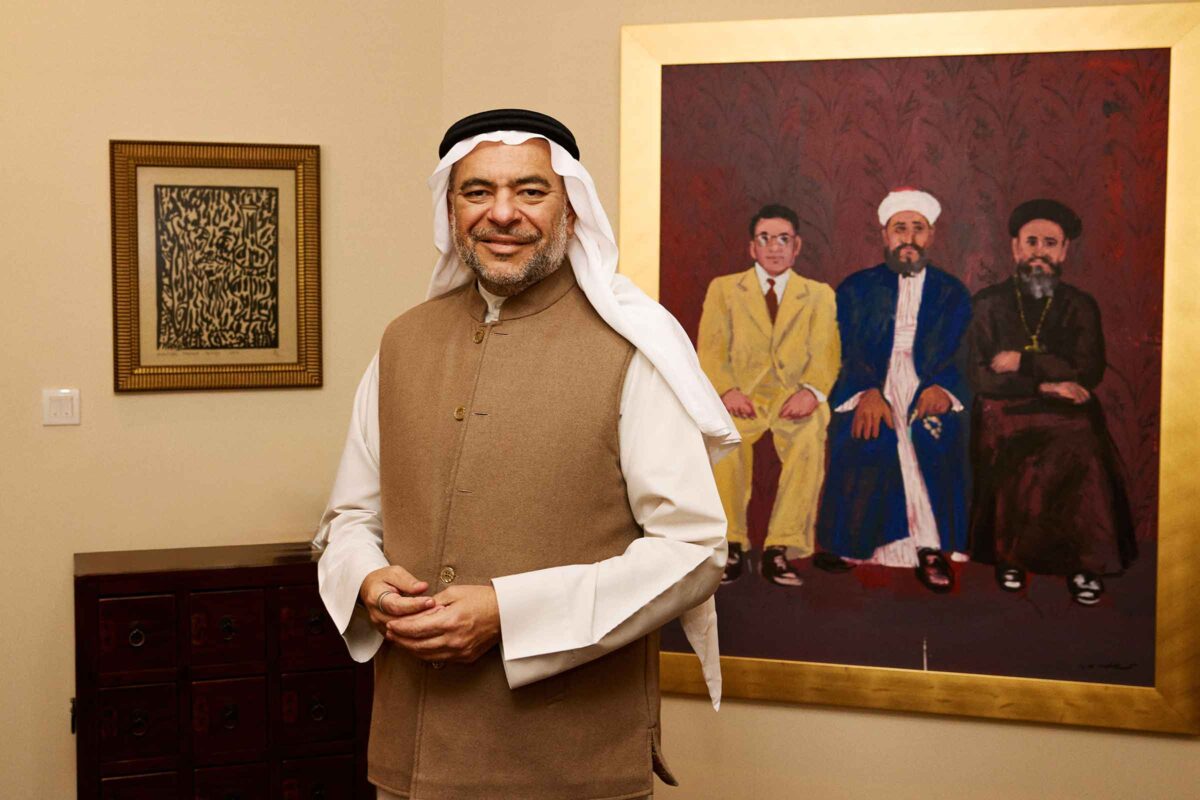
Shehab Gargash is a man driven by change. As the fourth generation of the Gargash family and the man steering one of the UAE’s most respected conglomerates, he is custodian of a business that predates the country itself. Yet sit down with Shehab and it becomes clear he is far less interested in polishing legacy than questioning it – and, if necessary, quietly dismantling parts of it.
“Change is imposed upon you,” he says. “If you fight it, it’s to your own detriment.”
It is a deceptively simple line, but it underpins how he approaches leadership at Gargash Group – a business spanning automotive, real estate, financial services and investments, employing thousands, and woven into the commercial fabric of the UAE.
For all the talk of heritage, the group’s Managing Director and Group CEO is blunt about one thing: nostalgia is not a strategy.
The problem with standing still
Family businesses, he argues, are often romanticised as guardians of tradition. In reality, clinging to the past can be a slow form of self-sabotage. “If we think a family business can cling on years and decades later to the way it operated in the past successfully, we will be doing the family a disservice.”
Modernisation, for him, is not a one-off initiative or a management fad. It is constant, slightly uncomfortable evolution. “You have to read the room,” he says. “You have to see the family dynamics, the outside environment, what has changed – and evolve with that.”
Dubai’s pace only sharpens the point. While the city’s growth is unusually visible, Shehab is clear this is not a Gulf-only phenomenon. From Europe to Asia, family-owned firms face the same choice: adapt or fade politely into irrelevance.
Legacy as tailwind, not destination
For someone often described as a steward of legacy, Shehab is refreshingly sceptical about the idea. “I don’t think we should care,” he says, without hesitation. “If I centre my decision-making process on protecting or creating a legacy, I fear my priorities are wrong.” Instead, he reframes legacy as a platform – a tailwind rather than a trophy. The past provides credibility and momentum, but the real test lies ahead. “You’re not starting from neutral,” he explains. “But the skill is reading the future well. The opportunity lies differently today than it did at any other time.”
It is an unusually unromantic view of inheritance. He likens leadership to a relay race: you take the baton, run your stretch as best you can, and pass it on. “I don’t really buy into fourth, eighth or nineteenth generation,” he says. “What matters is what you do with what you’re handed – and where you hand it off.”
The subtext is clear. Carrying a famous family name can be less privilege than pressure. Shehab’s solution is to shed that weight altogether. “The family name is almost a burden,” he admits. “The expectation is you will carry that legacy and deliver it better, bigger, nicer at the end of your tenure. However, I’m not a believer in that. I’m a believer in change.”
The patient game
Ask about strategy and Shehab Gargash offers another valuable insight. Many successful family businesses, he says, did not start with a grand masterplan. “Families stumble upon what they’re good at,” he explains. “There is no grand scheme early on.”
What separates winners from also-rans is not foresight but execution. Identifying what you do well, then relentlessly making it work. Over time, businesses diversify, but only where activities strengthen each other. “They act in a symbiotic way,” he says, “so the sum of them elevates the whole.”
This philosophy explains the breadth of Gargash Group’s portfolio – and the patience behind it.
Nothing illustrates that better than the group’s relationship with Mercedes-Benz, which began in 1958, long before the UAE had highways to accommodate luxury saloons.
“Who knew Mercedes-Benz in the Gulf would play the role it plays today?” Shehab says. “There was no sizeable road network back then.”

The longevity of the partnership, now stretching beyond six decades, rests on a simple principle: mutual responsibility. “It’s a two-way street,” he says. “They have a role to play, and we have a role to play. And both sides have to do that responsibly.”
People have come and gone on both sides – owners, executives, management teams – but the relationship endures because it remains mutually beneficial. It is a lesson in how global partnerships survive personality changes, market cycles and generational shifts.
Expansion to Shehab Gargash comes in two forms – one is doing what you currently do better, and the other one is doing something completely new. “We significantly broadened the appeal of car ownership by introducing leasing, and that plays an important part of our car sales strategy. Traditionally, car sales relied heavily on upfront cash purchases, but that model alone no longer supports sustainable growth. Leasing allowed us to remove barriers to ownership, reach a wider customer base, and adapt to changing consumer expectations, while continuing to do what we have always been known for: selling cars, just in a smarter and more accessible way.”
Old cars, new cities
Shehab is a genuine car man. Each December, he swaps boardrooms for open roads at the Mille Miglia-style rally in the UAE, piloting classic cars through desert landscapes. This year, his car of choice was a 1957 Mercedes-Benz 190 SL convertible.
Classic cars, he believes, matter precisely because they are not too old. “If I bring a 1930s car here, there’s no association,” he explains. “But a 1960s or 70s car lights a bulb in people’s imagination. They grew up with that design, that technology.”
Heritage, again, must remain relevant.
EVs and realism
From carburettors to kilowatts, Shehab is pragmatic about electrification. EVs are not a passing craze, but neither are they a solved problem. “The hopes may have been too ambitious,” he admits. Charging times, range anxiety and battery disposal still raise questions.
Yet he is clear on direction of travel. “To think EVs came and went is wrong,” he says. “The technology will catch up.” He drives an electric Mercedes-Benz G-Wagon himself, a vehicle that cleverly mimics its petrol sibling’s sound and feel. It is a lesson manufacturers are learning: adoption comes faster when change feels familiar.

Growth by refusal to mature
Despite operating in what many consider ‘mature’ sectors – automotive and real estate – Shehab rejects the label. “We have never accepted that we are a mature business,” he says. “We have always thought we are a growth business.” That mindset has delivered results. The group has seen roughly threefold growth over eight years by refusing to settle for incrementalism. Double-digit growth, year on year, remains the expectation.
The most exciting frontier? Financial services. “It has the most potential,” he says, partly because it is still the smallest part of the portfolio. Growth, after all, excites him more than maintenance. “I am not a good keeper, I am not a good shepherd. I am somebody who is driven by the opportunity to grow something,” he admits.
Inclusion, not just affluence
One of the group’s most interesting expansions has been into consumer finance – a first in its century-long history. The motivation is not serving the already wealthy, but the overlooked middle.
“The opportunity is for the unbanked,” Shehab explains. Dubai may project luxury, but beneath that lies a vast working population often excluded from credit.
Taxi drivers, retail workers, service staff – people who come to the UAE to better their lives but struggle to access basic financial tools. “People don’t come here for the hell of it,” he says.
“They come to improve their lives. Give them the tools.” It is a quietly radical idea in a city associated with excess: growth through inclusion.
Crypto, curiosity and the world lab
On crypto and blockchain, Shehab again resists extremes. The UAE’s willingness to experiment matters. “This country is a world lab,” he says. “You do experiments. Some fail. Many succeed.” Crypto remains in flux, but he believes something meaningful will endure – particularly as governments move from resistance to participation.
“This is the first time a 200- to 300-year-old concept of currency is being challenged,” he notes. “Something significant will come out of that.”
Curiosity, he insists, is non-negotiable. Businesses must keep their eyes open, even if many experiments fail. “You stumble upon things,” he says. “The skill is making them work.”
Sustainability without slogans
Sustainability, for Shehab, is neither virtue signalling nor political posture. “It should never be an end in itself,” he argues. “It should be a by-product of good business practice.”
The group now publishes its own sustainability report, measures progress against multi-year goals and taps into green financing where it makes sense. Environmental responsibility, social impact and philanthropy sit alongside commercial logic.
“If you achieve your goals through slashing and burning,” he says, “it doesn’t make for good business. It always comes back to bite you.”
Pickleball and perspective
Away from the business, Shehab’s downtime is disarmingly ordinary. He plays pickleball – once or twice a week when possible – having discovered the sport by accident after buying a home with a court close by. “You don’t need to master it to enjoy it,” he says. “That’s the beauty.”
Then there is Instagram, where he has built a following by doing the opposite of most would-be influencers. “I have no goal with it,” he shrugs. “It’s a hobby.” What he enjoys most about it is the storytelling.
I asked if there is a single leadership lesson he would post on the ‘gram, and he pauses. “Enjoy what you do,” he says finally. “Believe in what you preach – and have a plan to realise it.”
That combination – enjoyment, belief, execution – explains much about how Shehab Gargash leads. Legacy is respected but not worshipped. Heritage is honoured but not frozen. Growth is pursued with curiosity rather than ego. “You have to keep your eyes open, but it is trial and error at the end. That comes back to my theory of you stumble upon something, but the skill set is making it work.”
In a region often caricatured as obsessed with scale and spectacle, his approach feels quietly subversive. Less about monuments, more about momentum.
“Never close your mind to what evolution of the business environment brings you. There is something new happening every day, and you have to at least have the curiosity to find out what it’s all about.” The relay race continues.